Product video
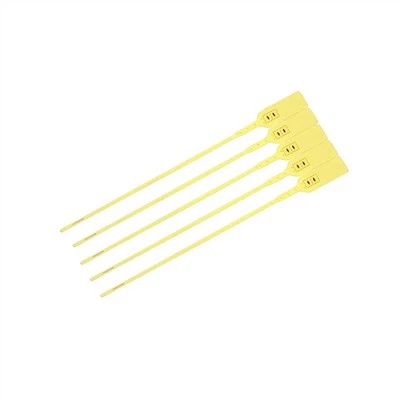
Product parameters
| Material: | Polypropylene(PP) |
|
Tape diameter: |
3.8mm |
| Total Length: | 380.0mm |
| Tensile Strength(N) | 200N |
| Printing method: |
1.Laser printing 2.Hot stamping 3.Thermal transfer |
|
Printable content: |
1.Customer's company name logo 2.Sequential number 3.Bar code/QR code |
| Colour: |
1.White,Yellow,Orange,Green,Blue,Red 2.Customized |
| Quantity per box: | 1000pcs |
| Box size: | 54*32*12cm |
| G.W. per box: | About 4.9kg |
product pictures


How to Choose the Choose the Right Security Seals
1. To understand what type of security best suits your business, first, understand what type of cargo is being protected.
Companies should analyse the value of the goods, the type of goods and their potential threats, whether intentional or unintentional, which would cover external environmental factors. Determine whether theft or tampering is a threat to the products and whether they have a history of being tampered, stolen or sabotaged. Assessing the risk of the nature of goods will provide a more detailed evaluation of the type of security seal best suitable.
2. Determine what value such goods will be to thieves, hijackers and pirates.
Certain products are more vulnerable to imminent theft such as high-cost cargo, electronics, pharmaceutical drugs, and expensive machinery. Untraceable goods are also common prey to theft as such goods can be resold, stored and transported illegally. For more extreme parties, dangerous goods such as weaponry, chemical substances, or explosive material may be targeted.
3. Education on the quality and types of seals is important for a company.
To have expertise in security seals areas can be a boon when determining the most suitable type of seal for each situation. Understand the differences of indicative, barrier and electronic seals and how each plays a part in different environments. Indicative seals can change shapes or its visual composition to show signs of the goods being tampered with. Locking bars and cable seals cannot be re-secured when forcefully cut open. These functions serve well to provide an indication of goods being tampered. Bolt seals, lock bars, cable seals are barriers. Electronic seals are equipped with Radio-Frequency Identification (RFID) with tracking capabilities. Identify the benefits and downsides between plastic seals and metal seals. Categorize plastic seals into its respective security levels, and similarly with metal seals. It is always advisable to inspect the seals physically to have better categorization standards.
4. Identifying the mode of transportation is beneficial to determining the suitable type of seal.
Different types of transportation methods are exposed to various environmental factors. In most cases, the size and shape of the cargo is a factor as well. Next, understanding Customs and Border Patrol's shipping regulations of every country will provide insight into the most suitable type of seal to purchase for security and meet the regulatory standard.
5. The seals' ability to be installed or removed should be inspected.
For some seals, notably electronic seals, a specific type of expertise in labour or technology is required. Such requirements should be well-prepared for as well as the proper operation manual of seals. Shippers or business owners should be educated on the proper application of the selected seal and whether a consignee agrees to the type of seal. To determine the most suitable seal for your business, choose a balance between security and simplicity. Both the seller and consignee parties will need to know how to operate the seals should training be required.
plastic seal components
Body
The plastic security seal's main part is typically made of durable and tough plastic material. The seal's body is designed to resist tampering and usually has a unique identification number or barcode printed on it.
01
Locking mechanism
The locking mechanism is part of the seal that secures it once it has been closed. Plastic security seals have various locking mechanisms, such as a pull-tight lock, snap lock, or insertion lock.
02
Tail (seal belt)
The seal's tail is a thin, flexible strip extending from the body to seal the secured item. The tail is usually thin enough to fit through small openings or gaps in the secured item but strong enough to resist being pulled or cut.
03
Tear-off tab
Some plastic security seals have a tear-off tab at the beginning of the tail. This tab allows the user to quickly and easily remove the seal without needing tools. This tear-off plastic seal is designed for temporary locking purposes, which can indicate tampering and, at the same time, easily be removed.
04
Hot Tags: 380 mm Small Pullback Sealed, China, suppliers, manufacturers, factory, customized, wholesale, price, cheap, in stock, free sample, made in China