


Introduction
In international shipping, container seals are an essential part of the container. In fact, all containers must be secured with at least one seal before a shipping line will allow it to be shipped.
These seals are numbered tags secured around the lock of a shipping container once it has been loaded.

What are Container Seals used for?
Once sealed, the seal cannot be opened without cutting it. Since it can only be removed once, this ensures that the container remains unopened until it has been delivered to the recipient.
As such, the main function of the seal is to deter the theft of goods, as any broken seal typically indicates that it has been tampered with.
It also minimizes the risk of an unauthorized person accessing the container to transport illegal cargo (such as contraband or drugs).
Common Types of Container Seals
Container seals can come in many shapes, sizes and materials.
Depending on the shipping line, exporter or the level of security required, containers can be secured with any kind of seal.
type Of Container Seals
Jiashan Yiwado Security Seals Manufacturer (Yoseal) specialized in producing security seals, has several years of industry leadership experience

Container Bolt Seal

Cable Seal

Padlock Seal
Where on the container should I place my seal?
Every shipping container has two doors that open outwards, with two lock rods on each door.
Typically, there are six locations on the container doors where you can lock the seal.
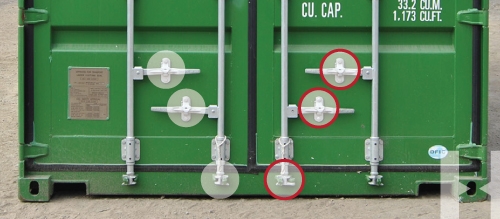
The left door closes first, followed by the right door. It is thus common practice to place the container seal on the right door of the container, as it will be opened first.
As can be seen the image above, the seals should thus be placed on any of the 3 lock rods on the right door (circled in red).
How do I put on the container seal?
For bolt seals, when it arrives, it should contain 2 parts: the top and bottom.
There should be a unique seal number on both pieces.
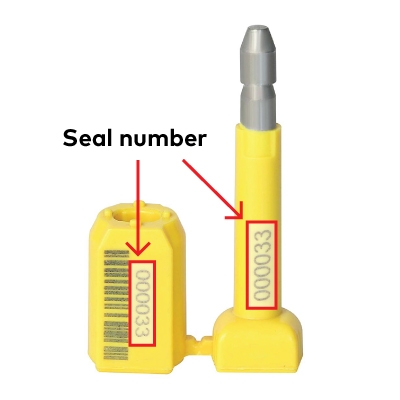
Bolt seal with a seal number on both parts.
To use the seal, you should snap the 2 pieces apart.
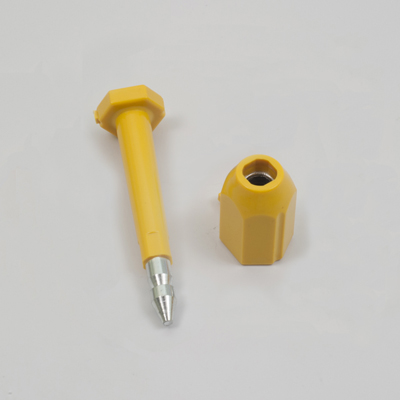
A bolt seal is made up of 2 parts.
When you are done with stuffing your container, close the doors, insert the pin through the hole, and connect the base to the pin to secure the bolt seal.
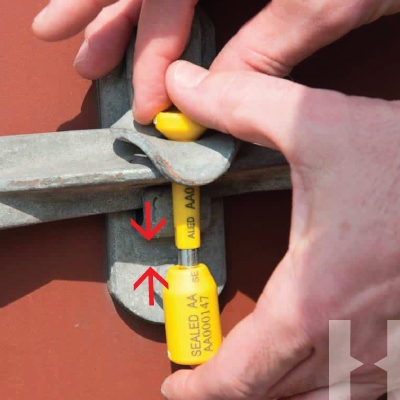
Locking a Bolt Seal
What are the numbers we see on a container seal?
Each seal should be identifiable by a series of numbers and/or letters.
In a typical export process, the prime mover driver will collect an empty container from the depot, together with a seal.
The haulier/shipper will need this seal number for documents related to the container, such as permit declaration, the electronic shipping note (ESN) and on the Bill of Lading (BL or BoL).
Note:It is up to the shipper to ensure that the correct seal number is listed on the Bill of Lading.
In Singapore, in order to enter the port with a container for export, hauliers will also need to provide Portnet with a seal number. This is to declare the cargo and the weight of the goods to be exported to the port authority.
Eventually, before opening the container, the recipient should check the seal number to see if the seal received is the same as the one listed in the Bill of Lading.
Note:Sometimes, different seal types (e.g. a bolt versus a cable seal) can have the same seal number. It is thus recommended for shippers or packing warehouses to take photos of the container after it has been properly sealed, to avoid confusion.
What should I do if my container seals are mismatched?
If there is a discrepancy between the seal and Bill of Lading, you should contact the shipping line immediately and try to get the issue resolved.
If possible, avoid opening or unloading the container until a representative of the shipping line is present. This is crucial in the event of a claim.
What should I do if my container seals are broken?
If the container seals are broken, it can mean that someone has been tampering with the goods or there has been a theft.
However, it can also mean that there the container has been selected for Customs inspection (refer to next point). In such cases, the new seals will be clearly marked so that you will know that it has been broken by Customs.
What happens when my container has been selected for Customs inspection?
In Singapore, the Singapore Customs conduct selective supervision of unstuffing of import containers and transhipment containers to ensure compliance with regulatory requirements.
This is usually done to check that all goods conveyed in the containers have been accurately declared to Customs.
Containers that have been identified for unstuffing under Customs supervision will be directed to the Red Lane by the Port Messaging System. There, your container will be checked by Customs officer(s).
Before the check, the original container seal will be removed. Afterwards, the container will be sealed again, this time with a Customs seal.
In Singapore, the container can be resealed with either a Customs red or green seal. For red seals, they may also be affixed with a warning sticker.